Legal Strategy
Owning Nothing, Controlling Everything: The Lanzo d’Intelvi IP Holding Blueprint
8 November 2025
In a world where companies trade in code, brands, and algorithms rather than factories, ownership is no longer the foundation of wealth,
control is.
The founders who thrive today are not those who own everything in one place, but those who build legal and geographical separation between what they do, what they own, and what they show.
In my article Milan to Lugano: The Hidden Corridor Where Lanzo d’Intelvi Redefines Business, I introduced Lanzo d’Intelvi as the hidden bridge between two financial worlds, Italy’s European soul and Switzerland’s financial precision. This borderland is not just scenic; it’s structural.
It’s where ideas can reside safely within the EU, royalties flow freely across borders, and value is controlled without being exposed.
1. The Philosophy: Separate What You Own from What You Operate
In A Contract Does What Accounting Can’t, I argued that legal structure is the true art of modern finance. Contracts, not spreadsheets, define where money sleeps and how it moves.
That logic extends here.
The smartest founders don’t consolidate assets and operations; they divide them.
The operating company runs the business, signs the contracts, hires the people, and takes the risk.
The holding company owns the trademarks, the software, the brand, and the creative IP that define the enterprise’s real value.
Between them sits a legal firewall, a thin layer of corporate separation that often decides who survives a crisis.
Lanzo d’Intelvi, with its low operational costs and access to EU and Swiss legal systems, offers the ideal soil for such separation to grow.
2. The Blueprint: Lanzo SRL → Dubai FZ → Swiss GmbH
Let’s deconstruct what I call The Lanzo d’Intelvi Blueprint, a three-jurisdiction architecture for IP holding and cashflow control.
Step 1: Lanzo SRL (IP Owner)
At the foundation of the structure stands the Lanzo SRL, a società a responsabilità limitata incorporated in the Province of Como under the Italian Civil Code (Articles 2462 et seq.), which governs limited-liability companies.
This entity serves as the intellectual-property owner of the entire group, the silent vault that holds the trademarks, patents, software, and proprietary know-how underpinning the brand.
By virtue of Italy’s membership in the European Union Intellectual Property Office (EUIPO), any trademark registered by the Lanzo SRL enjoys automatic protection across all twenty-seven EU Member States pursuant to Regulation (EU) 2017/1001 on the European Union Trade Mark.
Beyond the European umbrella, Italy’s network of more than 100 double-taxation treaties ensures that royalty flows to or from the SRL benefit from treaty-reduced or even nil withholding taxes, aligning with the principles set out in Article 23 of Italy’s Testo Unico delle Imposte sui Redditi (TUIR, Presidential Decree 917/1986).
The average price of real estate in Lanzo d’Intelvi sits at around €2,000 per square meter, a fraction of Milan or Lugano, which means you can secure corporate premises, residency, or a symbolic headquarters at negligible cost compared to any major city.
The Lanzo SRL can also access Italy’s Patent Box Regime (Decree Law n. 146/2021, converted by Law n. 215/2021), which grants a 110 percent super-deduction for R&D expenses related to qualifying intangibles, and the R&D Tax Creditunder Article 1, paragraphs 198 et seq. of Law 160/2019, further reducing its effective tax burden on innovation.
In practice, this means that a company holding software or trademarks in Lanzo d’Intelvi can lawfully attribute royalty income to the Italian entity while paying substantially lower taxes than a comparable Milan-based firm.
Geographically, Lanzo d’Intelvi strengthens the financial logic of the structure. Real-estate values average around €2,000 per square meter, a fraction of Milan or Lugano, allowing founders to acquire a physical office, residential base, or registered headquarter (sede legale) at minimal cost while still satisfying the “economic substance” criteria required by tax authorities under OECD BEPS Action 5. The result is a cost-efficient, fully compliant EU IP-holding seat: close enough to Switzerland to access its financial infrastructure, yet firmly connected in the legal certainty of the European Union.
Step 2: Dubai Free Zone Company, the Operational Core
The second pillar of the structure is the Dubai Free Zone Company, the operational engine through which commercial activity is executed and monetized. Formed under the UAE Commercial Companies Law (Federal Decree-Law №32 of 2021) and operating within one of the country’s many designated free zones, such as the Dubai International Financial Centre (DIFC), Abu Dhabi Global Market (ADGM), or RAK ICC, this entity is responsible for all client-facing operations: marketing, business development, and contract execution.
Unlike the Lanzo SRL, which remains passive and purely asset-holding, the Dubai FZ entity generates real commercial substance through staff, offices, and revenue generation. It then licenses the intellectual property from the Lanzo SRL under formal intragroup licensing agreements, paying royalties that are deductible under Article 28(1) of the UAE Corporate Tax Law (Federal Decree-Law №47 of 2022) provided they are at arm’s-length and serve a genuine business purpose.
Royalty and service payments to foreign affiliates benefit from the UAE’s extensive Double Tax Treaty network (more than 140 treaties worldwide), which in many cases eliminates or reduces withholding taxes on outbound payments, including those remitted to Italy under the Italy–UAE Convention for the Avoidance of Double Taxation (signed 1995, effective 1997). Consequently, royalties payable to the Lanzo SRL are fully deductible for the UAE operator, while the income may be taxed at a preferential rate in Italy under its Patent Box regime.
Crucially, companies registered in qualifying free zones that derive only passive income or foreign-source revenue may benefit from a 0 % corporate-tax rate on income that meets the “Qualifying Income” definition under Ministerial Decision №139 of 2023 (implementing Article 18 of the CT Law). This means that a Dubai operator engaged in international service provision or IP licensing can enjoy near-zero effective taxation, while still maintaining full legal compliance through proper substance, board meetings, and record keeping as mandated by Cabinet Resolution №44 of 2020 on Economic Substance Regulations.
In essence, the Dubai FZ entity acts as the commercial heartbeat of the structure, transforming the intangible assets held in Lanzo d’Intelvi into tangible revenue. It allows founders to leverage the UAE’s world-class infrastructure, international banking access, and absence of currency controls, all while remaining tethered to the protective shell of their European IP base.
Step 3: Swiss GmbH, the Credibility and Collection Hub
The final component of the structure is the Swiss GmbH, the entity that faces clients, signs contracts, and receives payments. Incorporated under Article 772 et seq. of the Swiss Code of Obligations (CO), the Gesellschaft mit beschränkter Haftung functions as the group’s commercial front. It anchors the structure in one of the world’s most respected business jurisdictions while maintaining operational agility and tax efficiency.
The Swiss GmbH typically bills international clients in Swiss francs (CHF) or euros, providing banking stability and reputational assurance. It then pays two forms of outflow (a) A service fee to the Dubai Free Zone operator for management and operational services, and (b) A royalty payment to the Lanzo SRL for the use of its intellectual property.
From a tax perspective, Switzerland remains competitive, with cantonal corporate income-tax rates ranging between 11 % and 15 % (Canton Ticino being toward the lower end) and full deductibility of both royalties and service fees provided they satisfy the arm’s-length principle under Article 58 of the Swiss Federal Tax Act (FTA).
Because Switzerland and Italy have a double-taxation treaty (1976, amended 2015), cross-border royalties enjoy reduced withholding rates (typically 5 %), while the Swiss-UAE treaty (2012) allows near-tax-free flows on certain service and dividend payments.
Operationally, the Swiss GmbH benefits from the Swiss–EU Bilateral Agreements, which grant it privileged access to the European market while preserving Switzerland’s financial privacy and banking advantages. Maintaining a small office or representative presence in Lugano, Mendrisio or Chiasso provides physical proximity to Lanzo d’Intelvi, a mere 25 minutes’ drive, creating a tangible cross-border ecosystem: Swiss contracts, Italian IP, Emirati operations.
This tri-jurisdictional alignment delivers a balanced triangle of credibility, efficiency, and protection.
Credibility: Swiss reputation and banking standards enhance client trust.
Efficiency: The Dubai FZ handles high-margin operations under near-zero tax exposure.
Protection: The Lanzo SRL shelters the core assets within the EU’s legal and treaty network.
This model aligns with OECD BEPS Actions 8–10 on transfer pricing and Action 5 on harmful tax practices, ensuring both compliance and optimization. The result is a structure that withstands regulatory scrutiny while extracting the maximum legal advantage from geography itself, a truly European-Emirati-Swiss design.
3. Why Lanzo Is Perfect for IP Holding
Lanzo d’Intelvi sits 30 minutes from both Lugano and Como, yet falls under Italian jurisdiction, giving it dual access to the EU legal environment and the Swiss financial corridor.
Lanzo d’Intelvi’s strength lies not only in its location between Milan and Lugano, but in the legal and economic architecture that this geography enables. Its appeal is multidimensional, a rare blend of jurisdictional leverage, regulatory stability, and quality of life that few places in Europe can replicate.
By incorporating in Italy, a member of the European Union, a Lanzo-based company benefits automatically from the EU-wide intellectual property regime. Under Regulation (EU) 2017/1001 on the European Union Trade Mark (EUTMR) and Regulation (EU) №6/2002 on Community Designs, an EU trademark or design registered through the European Union Intellectual Property Office (EUIPO) in Alicante grants protection in all 27 Member States with a single filing. This eliminates the need for multiple national registrations and centralizes enforcement before the EUIPO and EU General Court, streamlining IP management for international founders.
For a small SRL in Lanzo, this means that a brand or software name registered under Italian law is shielded across the continent, a strategic advantage at a fraction of the cost of a multi-jurisdictional portfolio.
Italy’s civil law system, codified under the Codice Civile of 1942, provides predictability and enforceability, essential elements for asset protection and contractual security.
Italian courts, particularly within the Tribunal of Como, have developed strong jurisprudence on commercial and corporate matters, ensuring that shareholder agreements, IP licenses, and cross-border contracts have a clear legal foundation.
Moreover, Italy’s adherence to EU directives on company law (Directive (EU) 2017/1132) and intellectual property enforcement (Directive 2004/48/EC) ensures that rights recognized in Lanzo d’Intelvi are harmonized with those of all EU partners. This makes Lanzo not merely a mountain retreat but a juridical safe zone, where the law speaks with both local depth and continental coherence.
The economic dimension is equally compelling. The cost of incorporation for an SRL (società a responsabilità limitata)in the Province of Como is markedly lower than in Milan, with reasonable notarial and registration fees. Annual maintenance, including accounting, filings, and domicile services, can remain below €3,000, a fraction of what a similar structure would cost in Zurich or Lugano. Office and residential real estate average around €2,000 per square meter, enabling founders to acquire a modest but compliant corporate base for less than the annual rent of a downtown Milan office.
This cost arbitrage transforms Lanzo from a rural enclave into a financially strategic jurisdiction, a place where legal presence, tax residency, and asset substance can coexist affordably.
The human factor completes the equation.
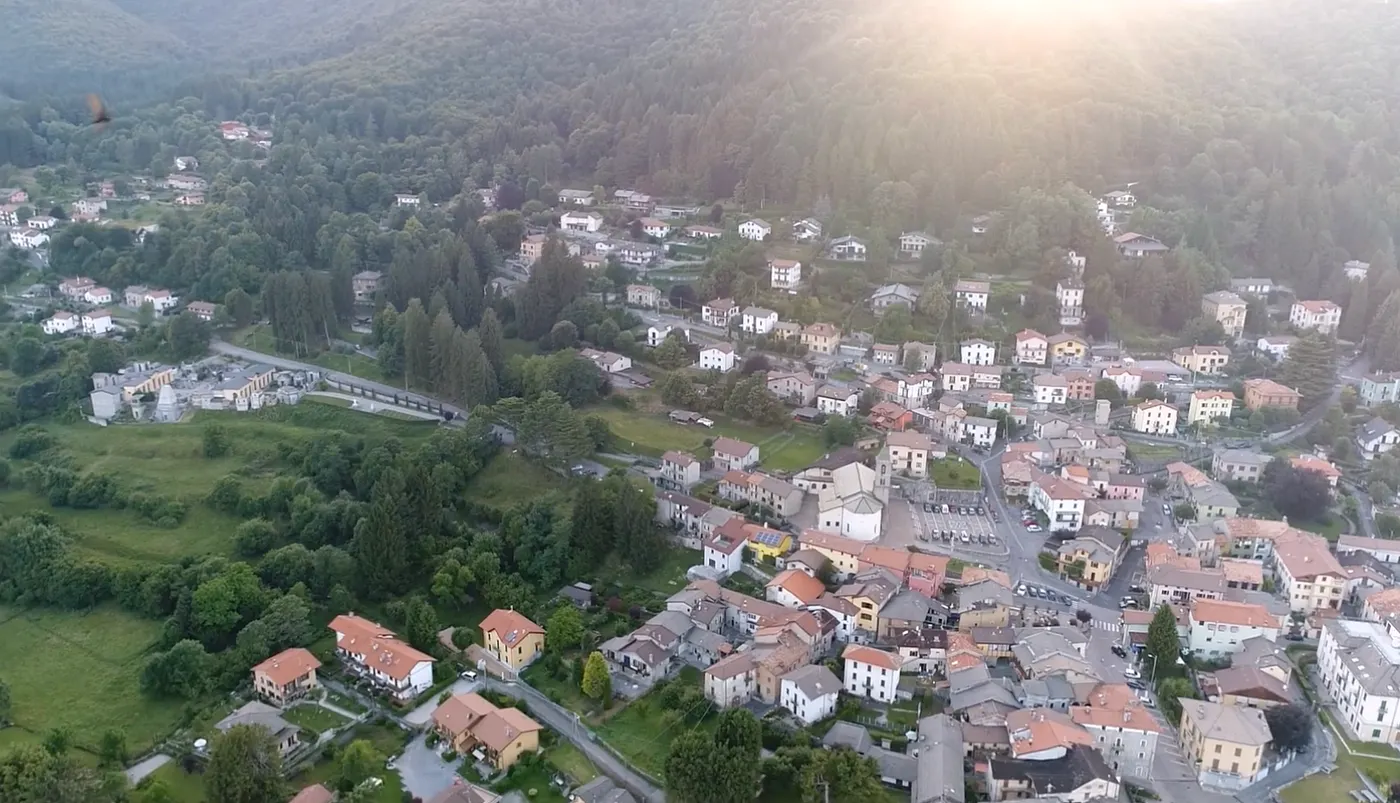
Lanzo offers an environment that is scenic yet connected, nestled in the Italian Alps, 30 minutes from Lake Como and Lugano, 45 minutes from Milan Malpensa Airport. It provides safety, community, and natural beauty while meeting the economic substance expectations outlined in OECD BEPS Action 5: a genuine office, a local address, and presence of decision-making within the jurisdiction. Founders can establish both residence and company headquarters in one setting, satisfying legal substance requirements while enjoying a lifestyle that enhances focus and creativity.
In short, Lanzo d’Intelvi is not simply between Italy and Switzerland; it sits at the intersection of law, lifestyle, and leverage, where the European legal order meets Swiss financial discipline, and where modern founders can own less but control more.
In From the Alps to the Gulf: How Milan, Zurich, and Dubai Are Redefining the Geography of Corporate Power, I described how capital now moves along “corridors of trust.” Lanzo d’Intelvi is one of those corridors, invisible to the casual observer, but essential to the sophisticated investor.
4. Control Without Exposure: The Legal Mechanics
Let’s talk about control.
You don’t need to “own” your brand personally to control it.
In A Vehicle for Wealth, Succession and Asset Protection for UAE Residents and European Individuals, I demonstrated how foundations, holding companies, and segregated ownership vehicles allow founders to separate title from power.
Lanzo d’Intelvi enables that same philosophy within the EU: a) The founder holds shares of the Lanzo SRL through a UAE or Italian foundation, b) The Lanzo SRL owns the IP and licenses it under defined terms, c) The operator (Dubai FZ) remits royalties, lowering its taxable base, and d) The client-facing Swiss entity maintains public visibility but minimal retained profits.
This system ensures that the individual remains invisible but indispensable. The person who controls flow, not form.
5. The Numbers: A Practical Example
To illustrate how this tri-jurisdictional framework functions in practice, consider a simple but realistic financial model.
A Swiss GmbH, incorporated in the Canton of Ticino, serves as the client-facing entity. It enters into service agreements with European clients and invoices an annual turnover of €1 million. Switzerland’s reputation for reliability allows contracts to be priced in euros or Swiss francs (CHF) and paid directly into a Swiss corporate account, ensuring transparency and credibility toward counterparties.
Out of this €1 million, the Swiss GmbH allocates two types of payments to its affiliates. The first is an operational service fee to the Dubai Free Zone company, which manages day-to-day functions such as marketing, customer service, and logistics. Let us assume this fee amounts to €200,000, reflecting the market value of the managerial and commercial work performed in the UAE. The second payment is a royalty to the Lanzo SRL for the use of its intellectual property, the software, brand, or proprietary process through which the business operates. A 10 percent royalty, or €100,000, is both economically justified and compliant with the arm’s-length principle established under OECD Transfer-Pricing Guidelines and incorporated in Article 110(7) of Italy’s Testo Unico delle Imposte sui Redditi (TUIR).
From the Swiss perspective, both outflows, the service fee and the royalty, are fully deductible business expenses under Article 58 of the Swiss Federal Tax Act, provided documentation supports their commercial rationale. The remaining profit in the Swiss GmbH, approximately €700,000, is then taxed at an effective cantonal rate of roughly 11–15 percent, depending on location. Switzerland’s double-taxation treaties with both Italy (1976, amended 2015) and the UAE (2012) ensure that these payments suffer minimal or no withholding tax, allowing efficient movement of funds within the group.
In Dubai, the Free Zone company receives its €200,000 fee as foreign-source income, typically qualifying for a 0 percent corporate-tax rate under Article 18 of the UAE Corporate Tax Law (Federal Decree-Law №47 of 2022) and Ministerial Decision №139 of 2023, provided the entity maintains adequate substance in its zone of incorporation. The payment of €100,000 in royalties to the Lanzo SRL is deductible under Article 28(1) of the same law, as it represents an ordinary expense incurred in the production of income.
Finally, the Lanzo SRL recognizes €100,000 in royalty income, which may be partially or entirely sheltered by the Patent Box regime introduced under Decree Law №146 of 2021 and the R&D tax-credit incentives of Law №160 of 2019. After applying the relevant super-deductions for qualifying intangible expenditures, the effective Italian tax rate on this income can fall well below the statutory 24 percent, sometimes approaching 10–12 percent for innovation-intensive businesses.
In practical terms, this means that the group retains most of its profit across compliant, well-substantive entities, each in a jurisdiction whose role is economically justified and legally defensible.
The end result is elegant in its simplicity:
The Swiss GmbH ensures credibility and contractual presence within continental Europe.
The Dubai Free Zone company drives operations and efficiency with minimal taxation.
The Lanzo SRL anchors ownership, R&D, and intellectual property under EU protection while benefiting from targeted fiscal incentives.
Together, these three pillars create a lawful equilibrium of tax optimization, asset protection, and operational logic, a living demonstration that when borders are designed rather than crossed, geography becomes strategy.
6. Risk Isolation: The Forgotten Dimension of Freedom
Every entrepreneur talks about freedom: few actually have it.
Real freedom isn’t the ability to move your money; it’s the ability to preserve it when things go wrong.
A product recall, client dispute, or regulatory audit can paralyze a company, but not a structure. By placing your brand and software under a Lanzo SRL, the core IP remains untouched even if your Dubai or Swiss operations face turbulence.
It’s the same principle I outlined in The European Soul, the Emirati Shield, diversification not by portfolio, but by jurisdiction.
7. Why Lanzo d’Intelvi Over Milan or Lugano?
At first glance, comparing Lanzo d’Intelvi to Milan or Lugano may seem like comparing a mountain village to two European powerhouses. Yet when examined through the lens of strategic substance, cost, and legal efficiency, Lanzo d’Intelvi quietly outperforms both.
Its strength lies not in scale, but in proportion, in offering precisely what modern founders, investors, and family offices need, and nothing they do not.
The economic advantage is undeniable.
The average price per square meter in Lanzo d’Intelvi hovers around €2,000, whereas similar residential or commercial properties in Lugano easily exceed €10,000 per sqm, and even modest Milan offices rarely fall below €6,000 per sqm. For a founder establishing a headquarters, legal domicile (sede legale), or residential base, this difference translates into enormous structural savings.
An entrepreneur can purchase a 50 sqm apartment in Lanzo for roughly €100,000, converting it into both a compliant residence and a registered office, a physical embodiment of economic substance under OECD BEPS Action 5. The same setup in Milan or Lugano would cost three to six times more, eroding capital that could instead fund R&D, brand building, or market expansion.
Moreover, operational overheads, from local tax (IMU) to accounting fees and notarial costs, are significantly lower in the Province of Como. The Chamber of Commerce of Como–Lecco offers simplified registration for small SRLs, with annual corporate maintenance costs that are a fraction of metropolitan rates.
In essence, Lanzo d’Intelvi provides a compliant European presence without the Milanese price tag.
From a regulatory standpoint, Lanzo enjoys the full protection of Italian corporate law under Articles 2462–2483 of the Civil Code, offering limited liability, flexibility in management, and the ability to form single-member SRLs (SRL unipersonali). Yet its proximity to the Swiss border gives it practical access to Swiss banks, logistics, and arbitration centers.
A Lanzo SRL can open bank accounts in nearby Mendrisio, Chiasso or Lugano, conduct business in euros or francs (CHF), and even engage with Swiss clients under cross-border service provisions without establishing a Swiss branch, all while maintaining Italian tax residency and access to EU directives such as the Parent–Subsidiary Directive (2011/96/EU) and the Interest and Royalties Directive (2003/49/EC).
This duality, EU legal coverage with Swiss financial connectivity, is the heart of Lanzo’s unique value proposition.
Unlike Milan, where corporate activity attracts higher local taxes and heavy bureaucracy, Lanzo d’Intelvi operates under the fiscal jurisdiction of the Province of Como, benefiting from lower regional IRAP rates and simplified local filings. Compared with Lugano, where Swiss compliance and audit thresholds apply even to small GmbHs, Lanzo d’Intelvi offers a lighter administrative burden under Legislative Decree №39/2010, exempting small SRLs from statutory audits until thresholds are exceeded.
Location matters, and Lanzo d’Intelvi’s geography is its hidden weapon.
Located in the Intelvi Valley, it sits 25 minutes from Lugano, 35 minutes from Lake Como, and 45 minutes from Milan Malpensa Airport. This positioning allows a founder or board member to operate seamlessly across three major ecosystems: the Swiss financial sector, the Italian industrial north, and the European Union’s legal zone.
It is not a coincidence that many cross-border professionals, lawyers, accountants, wealth managers, already reside in the Como–Lugano belt, commuting daily between jurisdictions. Lanzo thus fits naturally into a well-established transnational corridor, yet remains undervalued precisely because it lacks the noise of Milan or the luxury pricing of Lugano.
The municipality itself is business-friendly, with local authorities encouraging foreign ownership and second-residence investments. Utility connections, road infrastructure, and digital connectivity have improved dramatically in recent years, with fiber broadband coverage now reaching most of the Intelvi Valley.
The infrastructure is quiet, but complete.
Beyond balance sheets, Lanzo offers what Milan and Lugano cannot: quiet longevity.
It is a place where life and law coexist in proportion, where the founder can live in a stone house facing the Alps, walk to a café, cross to Switzerland for a meeting, and be back home before lunch.
From a residency standpoint, the Italian Elective Residency Visa (ERV) and “res non dom” taxation regime(introduced by Law 232/2016, Art. 1, para. 152 et seq.) allow foreign investors to relocate with favorable tax treatment, paying a fixed amount per year on foreign-sourced income. Coupled with Lanzo d’Intelvi’s affordable property and calm environment, this creates an ideal setup for founders who want European residence without metropolitan chaos.
Security, affordability, EU law, and Alpine beauty converge here. And while Milan dazzles and Lugano polishes, Lanzo d’Intelvi endures, quietly holding the middle ground where substance meets serenity.
Choosing Lanzo d’Intelvi over Milan or Lugano is not a matter of compromise but of strategy. It is the art of positioning one’s business and assets where the numbers make sense, the law offers clarity, and the landscape reminds you why you built something worth protecting.
8. Building the Future IP Hubs of Europe
Lanzo d’Intelvi’s appeal isn’t limited to individual founders. If clusters of small tech and creative firms adopted similar structures, Lanzo d’Intelvi could evolve into Europe’s boutique IP holding district, a “quiet Luxembourg” for the modern age.
Coworking spaces, legal chambers, and corporate service providers could anchor there, creating a micro-ecosystem of controlled value and international reach.
This is not speculation; it’s the same pattern we saw when Zug became “Crypto Valley.” Every revolution starts with a few visionaries who understand that geography is not a map, it’s a legal tool.
9. The Closing Argument: Design Your Silence
Owning nothing, controlling everything is not about secrecy, it’s about design.
A good structure doesn’t hide wealth; it defines it. It separates risk from reward, ownership from control, and exposure from power.
And sometimes, the best place to build that structure isn’t in a skyscraper, it’s in a mountain town with a view of two worlds, where a square meter still costs €2,000 and the law still rewards those who plan.
Lanzo d’Intelvi is not just a location. It’s a statement:
My assets are silent, but my structure speaks.
Originally published on my LinkedIn newsletter, The Quiet Advantage.
Need advice on a live matter?
Submit a confidential inquiry and briefly describe the situation.
Book Consultation